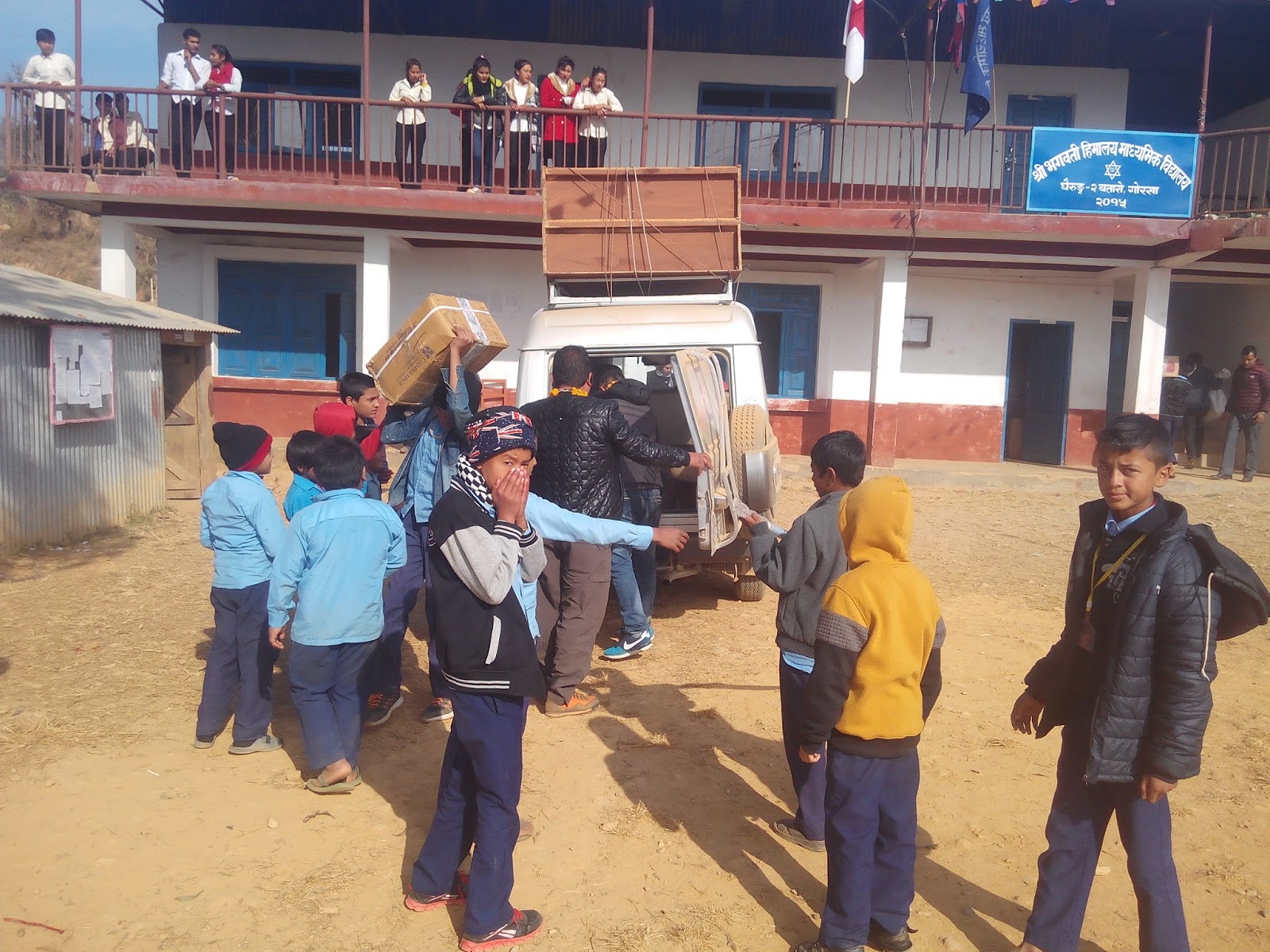
It's been a really great couple of weeks. This evening I'm off to Kathmandu for a few days, then next week I'll be starting the final round of school visits before I have to return to the UK.
Sunday, April 16, 2017
A jeep full of visitors and a happy new year!
It's been a really great couple of weeks. This evening I'm off to Kathmandu for a few days, then next week I'll be starting the final round of school visits before I have to return to the UK.
Sunday, April 02, 2017
Exam season!
It has been a quieter couple of weeks here in Nepal, as children across the country sit their end of year exams. These exams determine whether they will go up to the next class or have to repeat the year, so naturally, we don't want to cause any distractions and ty to avoid visiting schools during this period.
The days before the exams would have been busier, but for about half a week it barely stopped raining, meaning the roads to the schools I wanted to visit would be impassable. This also kept the electricity off for long periods, meaning I couldn't even do much office work. To stop myself going mad at the lack of action, Saran and I went along to Devwani School which is in Tansen. I couldn't do too much teaching with the children who were all revising or sitting mock exams. However, we saw that the new library was being put to great use. Over 600 books had already been checked out, with children from class 1 through to class 10 all using the library regularly. Our student librarians were keeping the library open during lunchtimes and have done a great job of keeping it looking tidy and organised for library users. It was a pleasure to present them all with some very well earned certificates.
We did manage to get to Gyanodaya School in Okhaldhunga before the exams started. I mentioned in a previous blog that during our last visit to the school we met a couple of orphans who were poor dressed and coming to school without exercise books or pencils. This time we were able to give them school uniforms, shoes, clothes and stationary to help them come to school without any worries.
Since then we've been working on our plans to open a Learning Resource Centre here in Tansen. I've been to see several potential buildings, and imagining the spaces full of books, computers and children learning is really exciting.
Later this afternoon we'll be welcoming Terri Broughton back to Tansen, with her husband Tony and friends Jenny and Dave. Terri is a retired headteacher from King's Lynn Academy, the twin school of Amrit here in Palpa. Over the next 10 days we'll visit Amrit and plenty of other schools, and I'm sure there'll be much more detail about what we get up to in my next post.
Thursday, March 23, 2017
Despair
I'm very aware that most of my blog posts are very upbeat and optimistic. Manisha UK does a lot of good in Nepal, which I get excited about and like to shout about. But there are days when I question whether this country, that I genuinely love, has the capacity or the mentality to develop. Yesterday was one of those days.
My wife is hoping to spend a year working in Korea (as am I). For her, as for so many young Nepalese, working abroad is the only way in which they can save money for the future. In order to do this, she needs to sit a Korean language exam with thousands of others, those with the best scores have a chance of being selected. Yesterday she went to pay the exam fee, about £20.
This should be a simple matter, but Nepal lacks basic financial infrastructure to such an extent, that in order to pay for her exam she must travel 2 hours to another city, to deposit the money in the exam organisers bank account. This is bad enough, but as there are thousands of people who want to take the exam and a limited window in which to pay the exam fee, the nominated bank can't cope and allow only 300 people each day to pay their fee. For my wife, that means spending the night in another city so she can get up at 4 am to go and join the queue. It means 2 days off work and a missed class lessening her chances of securing top marks in the exam.
How can a country hope to develop its economy when it is that hard to carry out what should be a very simple business transaction? There are so many ways that this could be done (online payments, paying at the exam centre on the day of the exam, sending payment via Western Union, or at least using a bank with a more extensive network of branches!) but so often Nepal seems determined to find the most difficult and least efficient way of getting things done.
After visiting the bank and finding all this out, we went for some food. I ordered my favourite treat of chicken fried MoMo. These were brought to me a boy of maybe 10 or 11 years old. I was the only one there who even seemed to notice that we were all being served by child labour, a child who should be in primary school but instead has already been condemned to a life of poverty, with the same almost certain for his future children. MoMo have never tasted so bitter to me and I genuinely felt sick all afternoon, regretting that I ate in such place.
Once again, I asked myself how a country can develop when exploitation of children is so readily accepted and normalised? When people can say, with a shrug of the shoulders, 'His family need the money' as if that makes it simple and ok?
Yesterday was a day of despair. Today, I look at these challenges and I don't know if they can be overcome, if Nepal can change. But today I will work harder and longer and I'll know that if Nepal fails, it won't be because we didn't try.
Saturday, March 18, 2017
Too busy to blog
It's been a fairly busy couple of weeks, returning to several of the new libraries we have installed, meeting with different groups of people to talk about the Learning Resource Centre project and getting around to visiting those schools that already had libraries.
We've now returned to each of the libraries we have set up in Palpa at least once and in some cases a couple of times. Schools are really making great efforts to utilise this resource and the check out registers show that children have been borrowing books to take home. At Nava Durga School in Pipaldanda 30 children borrowed over 125 books in a few weeks while at Devwani School here in Tansen we saw children returning with the books they had borrowed on the previous day, demanding they be taken to the library so they could borrow more. Needless to say, this is exactly what we hoped for and it was just so pleasing to see!
We arrived unannounced at Pipaldanda (we wanted to see how the library was really being used, not only when we were coming) and I was delighted to hear that the children would be having a cookery lesson in the afternoon. This sort of practical activity is really rare so I was curious to see how it would go. However, my enthusiasm was somewhat dampened when I saw two live chickens outside the office and realised that the lesson would involve butchering and cleaning the birds. I won't include any photos or videos, but I watched two year 5 children decapitate the chickens using a sickle. It was all very different to the cookery lessons I remember in school!
At Himalaya School in Mahachhap we heard the sad news that over the year four boys from class 4 had left school to go and work as labourers in another city. It's unlikely that they'll ever return to education and working as low paid labourers is likely to be their lot for life now, their futures determined before they even reach their teenage years. With little education, no literacy and limited earning potential, it's likely that in the future they will rely on their own children to support them, continuing the cycle of poverty.
We had great news yesterday from Bhagawati Himalaya School in Batase, Gorkha. The local government were so inspired by the library we provided, and the enthusiasm of the children to run it and use it, that they have managed to secure an extra £3000 funding from the Ministry of Education to add to and improve the library. The library we provided was good, but with this extra funding, the school should be able to manage a really top class facility!
Our project to set up a learning resource centre in Tansen with the Steve Sinnott Foundation continues to gather momentum. I've been meeting with and talking to children from different schools about what they would value in such a centre and how they would use it. I'd already spoken with a lot of schools 'top' students, but over the last couple of weeks, I've also managed to meet with students who struggle in school or are disengaged. The centre must be for all students so it is really important we gather a wide range of input. We've also set up a steering committee with school leaders, local government, local business and community and NGO representatives all on board to help ensure this is a full community effort. This has been really helpful in establishing what the local stakeholders really want and what we can realistically hope to achieve.
The 'mela' (a type of fair) has been in town with all sorts of strange delights. I've seen a dancing camel (with serious reservations over his living standards), cars driving around the wheel of death, some seriously unsafe rides and even more unsafe 'queues' (I use the term loosely, as it suggests some sort of order! For many attractions, the crowds simply pushed and shoved to get their first at severe risk of causing a crush, even on the children's rides) and been persuaded to buy all manner of shoddy merchandise and overpriced food. But it all made a welcome change to the routine and is a very healthy boost to the local economy.
During the last week Saran and I have visited the four schools that haven't had new libraries, and may be excused for feeling slightly neglected over the last couple of months. We spent time with the nursery teachers in each school, following up on training that Barbara and Hannah delivered last year, and made videos to send to the twin schools in the UK, either with student interviews or teaching how to count in Nepali. I was delighted to see that two schools have now not only provided their teachers with lesson planning diaries, but that they were actually being used. Teachers tend to follow text books here without planning lessons, but the planners showed teachers thinking about what resources they could use to improve lessons and giving consideration to what the actual point of the lesson was. A huge step forward and something to build on in the next few months.
We're coming toward the end of the school year now in Nepal. The all important year 10 exams have started this week, and nervous looking teenagers with their heads in books can been seen everywhere. All other classes will start their exams in a weeks time, right down from nursery class through to year 12. We'll still be busy with our work on the learning resource centre and delivering training to teachers who are not invigilating exams, but ensuring our school visits don't cause any unwelcome disruptions while students need to concentrate.
We've now returned to each of the libraries we have set up in Palpa at least once and in some cases a couple of times. Schools are really making great efforts to utilise this resource and the check out registers show that children have been borrowing books to take home. At Nava Durga School in Pipaldanda 30 children borrowed over 125 books in a few weeks while at Devwani School here in Tansen we saw children returning with the books they had borrowed on the previous day, demanding they be taken to the library so they could borrow more. Needless to say, this is exactly what we hoped for and it was just so pleasing to see!
We arrived unannounced at Pipaldanda (we wanted to see how the library was really being used, not only when we were coming) and I was delighted to hear that the children would be having a cookery lesson in the afternoon. This sort of practical activity is really rare so I was curious to see how it would go. However, my enthusiasm was somewhat dampened when I saw two live chickens outside the office and realised that the lesson would involve butchering and cleaning the birds. I won't include any photos or videos, but I watched two year 5 children decapitate the chickens using a sickle. It was all very different to the cookery lessons I remember in school! At Himalaya School in Mahachhap we heard the sad news that over the year four boys from class 4 had left school to go and work as labourers in another city. It's unlikely that they'll ever return to education and working as low paid labourers is likely to be their lot for life now, their futures determined before they even reach their teenage years. With little education, no literacy and limited earning potential, it's likely that in the future they will rely on their own children to support them, continuing the cycle of poverty.
We had great news yesterday from Bhagawati Himalaya School in Batase, Gorkha. The local government were so inspired by the library we provided, and the enthusiasm of the children to run it and use it, that they have managed to secure an extra £3000 funding from the Ministry of Education to add to and improve the library. The library we provided was good, but with this extra funding, the school should be able to manage a really top class facility!
Our project to set up a learning resource centre in Tansen with the Steve Sinnott Foundation continues to gather momentum. I've been meeting with and talking to children from different schools about what they would value in such a centre and how they would use it. I'd already spoken with a lot of schools 'top' students, but over the last couple of weeks, I've also managed to meet with students who struggle in school or are disengaged. The centre must be for all students so it is really important we gather a wide range of input. We've also set up a steering committee with school leaders, local government, local business and community and NGO representatives all on board to help ensure this is a full community effort. This has been really helpful in establishing what the local stakeholders really want and what we can realistically hope to achieve.
The 'mela' (a type of fair) has been in town with all sorts of strange delights. I've seen a dancing camel (with serious reservations over his living standards), cars driving around the wheel of death, some seriously unsafe rides and even more unsafe 'queues' (I use the term loosely, as it suggests some sort of order! For many attractions, the crowds simply pushed and shoved to get their first at severe risk of causing a crush, even on the children's rides) and been persuaded to buy all manner of shoddy merchandise and overpriced food. But it all made a welcome change to the routine and is a very healthy boost to the local economy.
During the last week Saran and I have visited the four schools that haven't had new libraries, and may be excused for feeling slightly neglected over the last couple of months. We spent time with the nursery teachers in each school, following up on training that Barbara and Hannah delivered last year, and made videos to send to the twin schools in the UK, either with student interviews or teaching how to count in Nepali. I was delighted to see that two schools have now not only provided their teachers with lesson planning diaries, but that they were actually being used. Teachers tend to follow text books here without planning lessons, but the planners showed teachers thinking about what resources they could use to improve lessons and giving consideration to what the actual point of the lesson was. A huge step forward and something to build on in the next few months.
We're coming toward the end of the school year now in Nepal. The all important year 10 exams have started this week, and nervous looking teenagers with their heads in books can been seen everywhere. All other classes will start their exams in a weeks time, right down from nursery class through to year 12. We'll still be busy with our work on the learning resource centre and delivering training to teachers who are not invigilating exams, but ensuring our school visits don't cause any unwelcome disruptions while students need to concentrate.
Tuesday, February 28, 2017
Sing me a song
![]() |
| Binod waiting to see the doctor |
The doctors told us that Binod is blind in one eye, with severely restricted vision in the other. Sadly, there is nothing that can be done to improve or restore his vision. Clearly, this wasn't the news anyone wanted, but now that we know the situation we have started taking specialist advice and will put together a plan, with resources needed, to help Binod access education and progress from nursery class. In spite of all this, I truly believe Binod had a very enjoyable day out, enjoying the jeep ride and playing with his balloon in the waiting room! He is still the same affectionate and happy little boy that volunteers have met over the years.
Before making the trip to remote Gyanodaya School in Okhaldhunga, there was just time to squeeze in a brief wedding anniversary celebration. It's hard to believe it's now two years since I married Bimala during my first trip to Nepal. It has been a crazy time but we're both still very happy and loving life here.
![]() |
| Reading in the sun |
![]() |
| Student librarian team at Gyanodaya |
![]() |
| Orphan boy and his friend with new books |
| Playing the 'madal' drum |
| The year 7 singers did a great job! |
![]() |
| More happy readers |
![]() |
| Year 10 leavers photos |
![]() |
| Students focused on the next quiz question |
It was good to see how children can make great use of resources, as I've been spending a lot of time working on our proposed joint project with the Steve Sinnott Foundation to set up a learning resource centre here in Tansen. The children really proved that if we can give them the access, they will put in the time and effort to get the most from them. Let's hope we can make the project a success!
Monday, February 13, 2017
Ma Nepali sikdiechhu (I am learning Nepali)
My New Year resolution was to finally start learning Nepali properly, rather than just try to pick it up as I go along. I was determined to start before the end of January and just managed it, taking my first class on the 31st. I've had a lesson most days since and feel like I'm making good progress, although don't worry fans, I'll be writing this blog in English for a good while yet! I've always found learning languages difficult, but for the first time I actually understand the verb conjugation and the various tenses, and although I still need loads of practice, especially with words full of vowels (try khuwaaueu (we fed) with it's five in a row!) I'm confident that I'll continue to improve and be able to meaningfully communicate with schools and my own family.
![]() |
| Year 5 at Nava Durga getting their first look at the new books |
![]() |
| Teachers at Himalaya learn how to level books |
We've continued setting up the new libraries and they are now established at Nava Durga Primary School in Pipaldanda, Himalaya Primary School in Mahachhap and Devwani Primary and Secondary School here in Tansen. The children have been really enthusiastic, often sneaking away from lessons or coming via the room we are setting up between classes to take a look. In all the schools, we've talked about how to care for the books and keep them in good condition and the children, despite their obvious excitement have been acting very responsibly. We'll be returning to these schools over the next couple of weeks to do more work with the teachers and the students, but it really has been exciting to see just how much children value the books we have delivered.
![]() |
| So many to choose from! |
We re-visited the first library we established at Kalankee Primary School. It turned out to be a very necessary visit, as although the school were using the library regularly and taking classes in, children hadn't been borrowing books because teachers were still unclear on how to fill in registers. Rather than just explain this again, we had each class in the library, demonstrated some reading activities, assessed reading levels together and had each child choose a book to take home. Now each teacher has done this with us, they are much more confident to be able to continue alone. We'll still return again to see how things are going and help clear up any difficulties or problems.
![]() |
| Children reading at Himalaya |
I've also managed to fit in my latest local TV appearance, this time having a rant about the amount of homework and (mainly pointless) copying children are expected to do, especially at primary level. This was at the Hope and Dream Montisorri School anniversary celebration, where I did enjoy seeing all young children (year 1 and younger) perform various cultural dances from various ethnic groups in Nepal, including my niece who did a great job!
The day after was my birthday, and although I wanted to go to school my wife banned me, so I spent a more relaxing day at home and enjoying a nice meal at one of Tansen's new hotels.
![]() | ||
| Children insist on helping carry the bookcase |
![]() |
| Boys reading at Himalaya |
Hope and Dreams isn't the only school celebration I've attended, as I was invited to Basanta Primary School in Bagnas for their 'school day'. We had to drop support for this school last year when they introduce fees, which goes against our policy, but I was curious to see how the school had got on since and this seemed an ideal opportunity. It was great to see some of the familiar students and teachers again and I enjoyed seeing the children's performances (although I can't say the same for adult's speeches). The school has taken on several new teachers, despite no very significant rise in the number of students, and although they've paid for some new school gates and exterior painting, the classrooms remain as dark and dingy as ever. I came away with the overall impression that the money they are collecting from fees isn't being used effectively to improve learning, and many worries about those students who's parents simply can't afford school fees.
I've been interviewing children again, this time at JVT School in Tansen, to get ideas about what they really need in a learning resource centre. I haven't got all the videos online yet, but they'll be available on our youtube and facebook pages. The children gave some great ideas, were clearly very motivated to learn and to have some practical experience to go with the theory they get in school.
![]() |
| Children show the correct way to put back books |
Next up will be a visit to Okhaldhunga, to establish our final library at Gyanodaya Secondary School. We've also got a visit to the eye hospital planned with Binod, a little boy from Kalankee Primary who we hope to be able to help. Apart from the school visits, there is plenty going on in Tansen, with a food fair coming, as well as the bi-annual Mela; a huge fair with some incredibly dodgy merchandise and even dodgier rides!
Wednesday, January 25, 2017
Lots of libraries!
January has been all about libraries. We started the year with library management training, delivered by Room to Read, ahead of starting to establish our first school libraries. We had a great training session and while the teachers learnt about library management, I got new ideas on how to conduct training sessions and some new activities I could use. These included some great warm up games such as indoor paper ball football in a circle.
During the session, teachers learnt how to level and label books, assess children's reading level, fill in book registers, arrange the furniture, manage the timetable and a host of things necessary for children to fully benefit from the libraries we are delivering.
As government schools were on holiday, I spent a couple of days at a local Montisorri nursery, which is run by a friend of the charity and attended by my niece. This is certainly the most expensive school in the local area (although well under £20 a month, it's far too expensive for most people here) and probably the best. However, even here I was reminded just how far education in Nepal has to go, as children spent ages waiting around doing nothing, copying and repeating endlessly and with a massive emphasis on homework (for four year olds!!!) Parent pressure is a serious issue to contend with as they put pressure on schools to provide homework, regardless of whether that homework is beneficial. In most cases, it adds nothing to children's learning but takes away an hour of learning at school while the teacher writes the homework to be done in each child's exercise book.
With the Steve Sinnott Foundation, we are looking at the possibility of establishing a learning resource centre here in Tansen. We heard a lot of good things about a similar project in a Nepali village 'a few hours' to the north, so decided to pay a visit. These few hours meant 4 hours on the back of a motorbike to Pokhara, an overnight stay there, then another 4 hours on the back of the bike on seriously dodgy jungle roads to reach the village of Phalebas, where Moti Community Library is situated. Having arrived in what appeared to be the middle of nowhere, I was stunned to see a large library building, with thousands of books, including children's collections and sections in Nepali, Hindi and English. As well as books there were computers, where women from the village were receiving typing training, sewing machines where more women were learning tailoring, an audio-visual room, a meeting hall and a women's' saving cooperative. The library management was really helpful and we talked at length about the difficulties of running such a centre, who it could benefit and what the most important aspects were. It gave loads of good ideas that we'll be able to learn from as we seek to bring similar benefits to people in Palpa.
When we arrived back in Tansen, all the things we had been waiting for to establish our own school libraries started to arrive. In a few days, we had 3000 books, bookcases, shutters and stickers. This meant some long and busy days sat in the office, sorting and cataloguing books, and painstakingly applying a level sticker to each, reinforced with sellotape. Not as exciting as winding jungle roads with Himalayan views or as fun as the hokey-cokey with excited children, but necessary work and all part of the job! We were able to establish our very first library at Kalankee Primary School, where we'll return in a few weeks to see how pupils have been able to use it.
This week we've made the long trip to Bhagawati Himalaya Higher Secondary School. This is in Gorkha district, about 20 miles from the earthquake epicentre and the school was almost entirely destroyed. My last visit was almost exactly a year ago, when we agreed funding for four new classrooms. Needless to say, I was excited to see how much had changed!
As we got off the main road and on to the jeep trails that wind up to the village, I was struck by how much corrugated iron there was everywhere. In the immediate aftermath of the earthquake, many NGOs provided these to help people build temporary shelters so they could have a place to sleep. Now, there is barely a house, shop or goat shed that doesn't have a signifcant amount of this in it's construction. Of course, giving people shelter and a safe place to sleep is more important, but I couldn't help be saddened by how much this ruins the natural beauty of traditional village homes.
Destruction was still visable everywhere, approaching two years since the quake. The teacher that used to live in this home told us how his wife and child had to jump from the building when the earthquake struck. Such stories are far too common and many don't have happy endings.
We spent 3 days in the school, setting up the library and delivering training. The students were absolutely delighted with the library and couldn't wait to get in and start using the books. In the first two days more than 60 books were checked out before we'd even officially invited a single student in! It was obvious that demand went beyond a once a week session in the library as a class, as students crowded the room during lunch time. We asked for volunteers from some of the older classes who could act as student librarians and open the library during lunch time and after school, and we were not dissapointed! We now have a team of 12 students who will do much of the day to day running of the library and are already brimming with ideas for improvements!
The enthusiasm of the students throughout the school was great to see. They have a real hunger to learn, especially at secondary level. So many students were coming in to the library while we were setting up or training and although this didn't make the job any easier, I was overjoyed to see it. By the end of lunch time on the second day we had tidied the library at least half a dozen times and had to have each class in to explain how the shelves are organised and how to put the books back, but this is far better than a scenario where the library remains tidy buy unused!
We were hosted by a family from the school management committe who looked after the 3 of us (Saran, the jeep driver and myself) exceptionally well. We arrived about 8pm on Saturday night and a lot of teachers turned out to welcome us with drinks, a lot of catching up and even more food. We slept in yet another building contructed or corrugated iron, but this was far more comfortable than than the temporary shelters so many families are still sleeping in.
The 4 new classrooms that we helped to construct look fantastic, with solid plastered walls and smooth floors (and yet more corrugated iron for the roof!). We spoke with some of the students about their experiences in the temporary classrooms and how different it was now. We heard repeatedly how in the temporary rooms they could barely hear the teacher or each other as noise travelled from room to room and everyone competed to be heard. Almost all the students talked about either the hot, the cold or the rain, depending on which season had effected them the most, but it was clear that the rooms were not comfortable at any time of the year!
We interviewed four students about their experience in the temporary classrooms, their plans for the new library, their experience of the earthquake and their hopes for the future. (With apologies for the sound quality).
Other schools are currently installing shutters we've providing, or finishing plastering walls, then we'll be off to establish our next 4 libraries. Plently more details coming here soon!
As government schools were on holiday, I spent a couple of days at a local Montisorri nursery, which is run by a friend of the charity and attended by my niece. This is certainly the most expensive school in the local area (although well under £20 a month, it's far too expensive for most people here) and probably the best. However, even here I was reminded just how far education in Nepal has to go, as children spent ages waiting around doing nothing, copying and repeating endlessly and with a massive emphasis on homework (for four year olds!!!) Parent pressure is a serious issue to contend with as they put pressure on schools to provide homework, regardless of whether that homework is beneficial. In most cases, it adds nothing to children's learning but takes away an hour of learning at school while the teacher writes the homework to be done in each child's exercise book.
With the Steve Sinnott Foundation, we are looking at the possibility of establishing a learning resource centre here in Tansen. We heard a lot of good things about a similar project in a Nepali village 'a few hours' to the north, so decided to pay a visit. These few hours meant 4 hours on the back of a motorbike to Pokhara, an overnight stay there, then another 4 hours on the back of the bike on seriously dodgy jungle roads to reach the village of Phalebas, where Moti Community Library is situated. Having arrived in what appeared to be the middle of nowhere, I was stunned to see a large library building, with thousands of books, including children's collections and sections in Nepali, Hindi and English. As well as books there were computers, where women from the village were receiving typing training, sewing machines where more women were learning tailoring, an audio-visual room, a meeting hall and a women's' saving cooperative. The library management was really helpful and we talked at length about the difficulties of running such a centre, who it could benefit and what the most important aspects were. It gave loads of good ideas that we'll be able to learn from as we seek to bring similar benefits to people in Palpa. When we arrived back in Tansen, all the things we had been waiting for to establish our own school libraries started to arrive. In a few days, we had 3000 books, bookcases, shutters and stickers. This meant some long and busy days sat in the office, sorting and cataloguing books, and painstakingly applying a level sticker to each, reinforced with sellotape. Not as exciting as winding jungle roads with Himalayan views or as fun as the hokey-cokey with excited children, but necessary work and all part of the job! We were able to establish our very first library at Kalankee Primary School, where we'll return in a few weeks to see how pupils have been able to use it.
This week we've made the long trip to Bhagawati Himalaya Higher Secondary School. This is in Gorkha district, about 20 miles from the earthquake epicentre and the school was almost entirely destroyed. My last visit was almost exactly a year ago, when we agreed funding for four new classrooms. Needless to say, I was excited to see how much had changed!
As we got off the main road and on to the jeep trails that wind up to the village, I was struck by how much corrugated iron there was everywhere. In the immediate aftermath of the earthquake, many NGOs provided these to help people build temporary shelters so they could have a place to sleep. Now, there is barely a house, shop or goat shed that doesn't have a signifcant amount of this in it's construction. Of course, giving people shelter and a safe place to sleep is more important, but I couldn't help be saddened by how much this ruins the natural beauty of traditional village homes.
Destruction was still visable everywhere, approaching two years since the quake. The teacher that used to live in this home told us how his wife and child had to jump from the building when the earthquake struck. Such stories are far too common and many don't have happy endings.
![]() |
| The first student to check out a book! |
We spent 3 days in the school, setting up the library and delivering training. The students were absolutely delighted with the library and couldn't wait to get in and start using the books. In the first two days more than 60 books were checked out before we'd even officially invited a single student in! It was obvious that demand went beyond a once a week session in the library as a class, as students crowded the room during lunch time. We asked for volunteers from some of the older classes who could act as student librarians and open the library during lunch time and after school, and we were not dissapointed! We now have a team of 12 students who will do much of the day to day running of the library and are already brimming with ideas for improvements!
![]() |
| Secondary students using the library for the first time. |
The enthusiasm of the students throughout the school was great to see. They have a real hunger to learn, especially at secondary level. So many students were coming in to the library while we were setting up or training and although this didn't make the job any easier, I was overjoyed to see it. By the end of lunch time on the second day we had tidied the library at least half a dozen times and had to have each class in to explain how the shelves are organised and how to put the books back, but this is far better than a scenario where the library remains tidy buy unused!
![]() |
| Students were reading all over the school by lunch time on the second day. |
![]() |
| Our amazing student librarians! |
![]() |
| Year 4 children get their first taste of the library. |
Other schools are currently installing shutters we've providing, or finishing plastering walls, then we'll be off to establish our next 4 libraries. Plently more details coming here soon!
Subscribe to:
Posts (Atom)